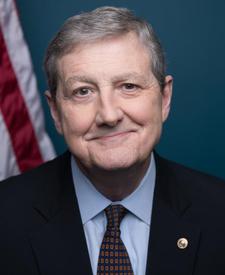
Official portrait of John Kennedy
RepublicanU.S. SenateJunior senator

John Kennedy

Louisiana · Official website · 202-224-4623
923
Positions recorded
119th Congress roll calls listing this member
16 of 923
Roll calls missed
Recorded "Not Voting" · Senate roll calls Jan 9, 2025 – Nov 16, 2026
85
Bills sponsored
119th Congress · Congress.gov
206
Bills cosponsored
119th Congress · Congress.gov

All figures are computed directly from the official House Clerk, senate.gov, and Congress.gov records for the 119th Congress. Methodology

Data last synced: votes Nov 17, 2026, 7:16 AM ET · bills Nov 17, 2026, 7:19 AM ET · floor remarks Nov 17, 2026, 8:56 AM ET · press releases Nov 17, 2026, 8:57 AM ET

119th CongressSponsored (85)Cosponsored (206)

S. 1322Family Notification of Death, Injury, or Illness in Custody Act of 2025

Progress: Introduction / referral onlyLatest action: Read twice and referred to the Committee on the Judiciary.
119th CongressPolicy area: Crime and Law Enforcement
  • Original cosponsorApr 8, 2025
Official CRS summary
Official CRS summary (Introduced in Senate version) · Congress.gov(opens in a new tab)

This bill requires the Department of Justice (DOJ) to develop policies and procedures for notifying next-of-kin or other emergency contacts in the event of the death, or serious illness or serious injury, of an individual in custody.

The bill requires DOJ to implement the policies and procedures at its detention agencies. Further, the bill requires DOJ to distribute model policies and procedures to state, territorial, tribal, and local detention agencies.

Introduced Apr 8, 2025
Latest action Apr 8, 2025Congress.gov(opens in a new tab)GovInfo action history(opens in a new tab)Status checked Nov 15, 2026Record permalink

S.Res. 159A resolution honoring the life of the Honorable John Bennett Johnston, Jr., former Senator for the State of Louisiana.

Progress: Passed / agreed in one chamberLatest action: Submitted in the Senate, considered, and agreed to without amendment and with a preamble by Unanimous Consent. (consideration: CR S2459; text: CR S2458)
119th CongressPolicy area: Congress
  • Original cosponsorApr 7, 2025
Introduced Apr 7, 2025
Latest action Apr 7, 2025Congress.gov(opens in a new tab)GovInfo action history(opens in a new tab)Status checked Nov 17, 2026Record permalink

S.J.Res. 46A joint resolution providing for congressional disapproval under chapter 8 of title 5, United States Code, of the rule submitted by the Environmental Protection Agency relating to "California State Motor Vehicle and Engine Pollution Control Standards; Heavy-Duty Vehicle and Engine Emission Warranty and Maintenance Provisions; Advanced Clean Trucks; Zero Emission Airport Shuttle; Zero-Emission Power Train Certification; Waiver of Preemption; Notice of Decision".

Progress: Introduction / referral onlyLatest action: Read twice and referred to the Committee on Environment and Public Works.
119th CongressPolicy area: Environmental Protection
  • Original cosponsorApr 4, 2025
Official CRS summary
Official CRS summary (Introduced in Senate version) · Congress.gov(opens in a new tab)

This joint resolution nullifies the Environmental Protection Agency notice titled California State Motor Vehicle and Engine Pollution Control Standards; Heavy-Duty Vehicle and Engine Emission Warranty and Maintenance Provisions; Advanced Clean Trucks; Zero Emission Airport Shuttle; Zero-Emission Power Train Certification; Waiver of Preemption; Notice of Decision (88 Fed. Reg. 20688) and published on April 6, 2023. Among other elements, the notice grants the California Air Resources Board request for a waiver several of its regulations, including the Heavy-Duty Vehicle and Engine Emission Warranty Regulations and Maintenance Provisions. (Under the Clean Air Act, California may seek waivers of the preemption prohibiting states from enacting certain emission standards.)

Introduced Apr 4, 2025
Latest action Apr 4, 2025Congress.gov(opens in a new tab)GovInfo action history(opens in a new tab)Status checked Oct 29, 2026Record permalink

S.J.Res. 45A joint resolution providing for congressional disapproval under chapter 8 of title 5, United States Code, of the rule submitted by the Environmental Protection Agency relating to "California State Motor Vehicle and Engine Pollution Control Standards; Advanced Clean Cars II; Waiver of Preemption; Notice of Decision".

Progress: Introduction / referral onlyLatest action: Read twice and referred to the Committee on Environment and Public Works.
119th CongressPolicy area: Environmental Protection
  • Original cosponsorApr 4, 2025
Official CRS summary
Official CRS summary (Introduced in Senate version) · Congress.gov(opens in a new tab)

This joint resolution nullifies the Environmental Protection Agency notice titled California State Motor Vehicle and Engine Pollution Control Standards; Advanced Clean Cars II; Waiver of Preemption; Notice of Decision (90 Fed. Reg. 642) and published on January 6, 2025. Among other elements, the notice grants the California Air Resources Board request for a waiver for its Advanced Clean Cars II (ACC II) regulations. (Under the Clean Air Act, California may seek waivers of the preemption prohibiting states from enacting certain emission standards.)

Introduced Apr 4, 2025
Latest action Apr 4, 2025Congress.gov(opens in a new tab)GovInfo action history(opens in a new tab)Status checked Nov 15, 2026Record permalink

S. 1292Save Our Seafood Act

Progress: Introduction / referral onlyLatest action: Read twice and referred to the Committee on the Judiciary.
119th CongressPolicy area: Immigration
  • Original cosponsorApr 3, 2025
Official CRS summary
Official CRS summary (Introduced in Senate version) · Congress.gov(opens in a new tab)

This bill establishes that the annual numerical cap on temporary nonagricultural worker (H-2B) visas does not apply to fish processors.

Under current law, up to 66,000 H-2B visas may be issued in a year, with additional visas available to certain classes of workers who are exempt from this cap, including fish roe processors.

Introduced Apr 3, 2025
Latest action Apr 3, 2025Congress.gov(opens in a new tab)GovInfo action history(opens in a new tab)Status checked Oct 29, 2026Record permalink

S. 1241Sanctioning Russia Act of 2025

Progress: Introduction / referral onlyLatest action: Read twice and referred to the Committee on Banking, Housing, and Urban Affairs.
119th CongressPolicy area: International Affairs
  • Original cosponsorApr 1, 2025
Official CRS summary
Official CRS summary (Introduced in Senate version) · Congress.gov(opens in a new tab)

This bill imposes penalties on certain persons (individuals and entities) if the President determines that the Russian government or a person acting at Russia's direction is involved with (1) refusing to negotiate a peace agreement with Ukraine; (2) violating a negotiated peace agreement; (3) initiating another invasion of Ukraine; or (4) overthrowing, dismantling, or seeking to subvert the Ukrainian government.

If the President makes such a determination, the bill requires certain actions including

  • the President must impose visa- and property-blocking sanctions on specified persons such as the Russian president, certain Russian military commanders, and any foreign person that knowingly provides defense items to the Russian armed forces;
  • the President must increase the rate of duty on all goods and services imported from Russia into the United States to at least 500% relative to the value of such goods and services;
  • the President must increase the rate of duty on all goods and services imported into the United States from countries that knowingly engage in the exchange of Russian-origin uranium and petroleum products to at least 500% relative to the value of such goods and services;
  • the Department of the Treasury must impose property-blocking sanctions on any financial institution organized under Russian law and owned wholly or partly by Russia, and any financial institution that engages in transactions with those entities; and
  • the Department of Commerce must prohibit the export, reexport, or in-country transfer to or in Russia of any U.S.-produced energy or energy product.
Introduced Apr 1, 2025
Latest action Apr 1, 2025Congress.gov(opens in a new tab)GovInfo action history(opens in a new tab)Status checked Nov 17, 2026Record permalink

S. 1236FISCAL Act

Progress: Introduction / referral onlyLatest action: Read twice and referred to the Committee on Agriculture, Nutrition, and Forestry.
119th CongressPolicy area: Agriculture and Food
  • Original cosponsorApr 1, 2025
Official CRS summary
Official CRS summary (Introduced in Senate version) · Congress.gov(opens in a new tab)

This bill revises requirements for milk provided by the National School Lunch Program of the Department of Agriculture (USDA) to require that schools offer plant-based milk.

Under current law, schools must provide a substitute for fluid milk for students whose disability restricts their diet (on receipt of a written statement from a licensed physician). Schools may also substitute a nondairy beverage for fluid milk for students who have an identified medical or other special dietary need (on receipt of a written statement from a medical authority or a student's parent or legal guardian).

The bill eliminates the exceptions and documentation requirements. Instead, schools participating in the school lunch program must offer all students a plant-based milk option that is consistent with (1) the most recent U.S. Dietary Guidelines, or (2) USDA-established nutritional standards if the milk is not included under those guidelines.

Introduced Apr 1, 2025
Latest action Apr 1, 2025Congress.gov(opens in a new tab)GovInfo action history(opens in a new tab)Status checked Nov 15, 2026Record permalink

S.J.Res. 24A joint resolution providing for congressional disapproval under chapter 8 of title 5, United States Code, of the rule submitted by the Environmental Protection Agency relating to "National Emission Standards for Hazardous Air Pollutants: Rubber Tire Manufacturing".

Progress: Introduction / referral onlyLatest action: Read twice and referred to the Committee on Environment and Public Works.
119th CongressPolicy area: Environmental Protection
  • CosponsorApr 1, 2025
Official CRS summary
Official CRS summary (Introduced in Senate version) · Congress.gov(opens in a new tab)

This joint resolution nullifies the Environmental Protection Agency rule titled National Emission Standards for Hazardous Air Pollutants: Rubber Tire Manufacturing (89 Fed. Reg. 94886) and published on November 29, 2024. The rule addresses the decision in Louisiana Environmental Action Network v. EPA (D.C. Cir. 2020) by implementing emissions standards for the rubber processing subcategory of the rubber tire manufacturing industry to ensure all emissions of hazardous air pollutants from sources in the source category are regulated.

Introduced Apr 1, 2025
Latest action Feb 25, 2025Congress.gov(opens in a new tab)GovInfo action history(opens in a new tab)Status checked Nov 15, 2026Record permalink

S. 1206Judicial Relief Clarification Act of 2025

Progress: Introduction / referral onlyLatest action: Read twice and referred to the Committee on the Judiciary. (Sponsor introductory remarks on measure: CR S1925-1926)
119th CongressPolicy area: Law
  • Original cosponsorMar 31, 2025
Introduced Mar 31, 2025
Latest action Mar 31, 2025Congress.gov(opens in a new tab)GovInfo action history(opens in a new tab)Status checked Oct 29, 2026Record permalink

S.Res. 148A resolution honoring the life of the Honorable Alan K. Simpson, former Senator for the State of Wyoming.

Progress: Passed / agreed in one chamberLatest action: Message on Senate action sent to the House.
119th CongressPolicy area: Congress
  • Original cosponsorMar 27, 2025
Introduced Mar 27, 2025
Latest action Mar 31, 2025Congress.gov(opens in a new tab)GovInfo action history(opens in a new tab)Status checked Oct 29, 2026Record permalink

S. 237Honoring Our Fallen Heroes Act of 2025

Progress: Other action recordedLatest action: Placed on Senate Legislative Calendar under General Orders. Calendar No. 78.
119th CongressPolicy area: Crime and Law Enforcement
  • CosponsorMar 24, 2025
Official CRS summary
Official CRS summary (Introduced in Senate version) · Congress.gov(opens in a new tab)

This bill extends death and disability benefits under the Public Safety Officers' Benefits Program (PSOB) to certain public safety officers who suffer from exposure-related cancer while on duty and their survivors. The PSOB program provides death, disability, and education benefits to public safety officers who are killed or injured in the line of duty and their survivors.

The bill specifies that exposure to a carcinogen shall be presumed to constitute a personal injury in the line of duty if

  • the exposure occurred while the officer was in the line of duty;
  • the officer began serving as an officer not fewer than 5 years before the date of the diagnosis of an exposure-related cancer and the diagnosis occurred not more than 15 years after the last date of active service; and
  • the exposure-related cancer directly and proximately resulted in the death or permanent and total disability of the officer.

The Department of Justice's Bureau of Justice Assistance must periodically review the definition of exposure-related cancer and update the definition if appropriate based on medical evidence and in accordance with the requirements of a petition process.

Introduced Mar 24, 2025
Latest action May 20, 2025Congress.gov(opens in a new tab)GovInfo action history(opens in a new tab)Status checked Nov 15, 2026Record permalink

S. 1082Safeguarding Medicaid Act

Progress: Introduction / referral onlyLatest action: Read twice and referred to the Committee on Finance. (text: CR S1778-1779)
119th CongressPolicy area: Health
  • Original cosponsorMar 14, 2025
Official CRS summary
Official CRS summary (Introduced in Senate version) · Congress.gov(opens in a new tab)

This bill requires states and territories to implement asset verification programs to determine an individual's Medicaid eligibility.

Currently, states, the District of Columbia, and Puerto Rico are required to have asset verification programs to determine an individual's eligibility for Medicaid if the individual is age 65 or older, blind, or disabled. The bill applies this requirement to all states and territories and to all individuals seeking Medicaid eligibility.

The bill also requires state Medicaid programs to implement resource tests to determine an individual's Medicaid eligibility (currently, such tests are prohibited except for those age 65 or older or who are blind or disabled). The resource test must conform with the resource test for determining an individual's eligibility for Supplemental Security Income, unless the state specifies a different threshold.

The Centers for Medicare & Medicaid Services (CMS) must create a system to track any federal savings due to implementation of the required asset verification programs.

States that do not comply with federal requirements regarding Medicaid eligibility determinations must submit corrective action plans to the CMS.

Introduced Mar 14, 2025
Latest action Mar 14, 2025Congress.gov(opens in a new tab)GovInfo action history(opens in a new tab)Status checked Nov 15, 2026Record permalink

S. 1032Major Richard Star Act

Progress: Introduction / referral onlyLatest action: Read twice and referred to the Committee on Armed Services.
119th CongressPolicy area: Armed Forces and National Security
  • Original cosponsorMar 13, 2025
Official CRS summary
Official CRS summary (Introduced in Senate version) · Congress.gov(opens in a new tab)

This bill allows a veteran with a combat-related disability to receive retirement pay, without reduction, concurrently with their disability compensation. This includes veterans with a combat-related disability and fewer than 20 years of creditable service. (Currently, veterans who receive combat-related special compensation and retirement pay are subject to an offset in retirement pay for concurrent receipt of such benefits.)

Introduced Mar 13, 2025
Latest action Mar 13, 2025Congress.gov(opens in a new tab)GovInfo action history(opens in a new tab)Status checked Nov 17, 2026Record permalink

S. 1020A bill to require the Federal Energy Regulatory Commission to extend the time period during which licensees are required to commence construction of certain hydropower projects.

Progress: Became lawLatest action: Became Public Law No: 119-90.
119th CongressPolicy area: Energy
  • Original cosponsorMar 13, 2025
Official CRS summary
Official CRS summary (Public Law version) · Congress.gov(opens in a new tab)

This act authorizes the Federal Energy Regulatory Commission (FERC) to extend construction deadlines for hydropower projects that were issued a license before March 13, 2020. FERC is authorized, upon the request of the licensees, to extend the deadline for beginning construction on such projects an additional six years beyond the eight-year extension FERC is authorized to provide under current law. The extension must consist of no more than three consecutive two-year periods.

The act also provides that FERC may reinstate certain expired licenses for projects with construction deadlines extended under this act, effective as of the date they expire.

Introduced Mar 13, 2025
Latest action May 11, 2026Congress.gov(opens in a new tab)GovInfo action history(opens in a new tab)Status checked Oct 29, 2026Record permalink

S. 1015A bill to extend the National Flood Insurance Program through December 31, 2026.

Progress: Introduction / referral onlyLatest action: Read twice and referred to the Committee on Banking, Housing, and Urban Affairs. (Sponsor introductory remarks on measure: CR S1745)
119th CongressPolicy area: Finance and Financial Sector
  • Original cosponsorMar 13, 2025
Introduced Mar 13, 2025
Latest action Mar 13, 2025Congress.gov(opens in a new tab)GovInfo action history(opens in a new tab)Status checked Nov 17, 2026Record permalink

S. 987Protecting Life and Integrity in Research Act of 2025

Progress: Introduction / referral onlyLatest action: Read twice and referred to the Committee on Health, Education, Labor, and Pensions.
119th CongressPolicy area: Health
  • Original cosponsorMar 12, 2025
Official CRS summary
Official CRS summary (Introduced in Senate version) · Congress.gov(opens in a new tab)

This bill prohibits federal agencies from supporting research involving, and prohibits any entity from soliciting or knowingly acquiring, human fetal tissue obtained pursuant to an induced abortion.

Specifically, the bill prohibits any federal agency from conducting, funding, approving, or otherwise supporting research involving such tissue. Federal agencies may conduct or support research involving human fetal tissue obtained after a miscarriage or stillbirth.

Additionally, the bill prohibits any entity from soliciting or knowingly acquiring, receiving, or accepting a donation of human fetal tissue where the entity knows it was obtained pursuant to an induced abortion. Entities violating this prohibition are subject to criminal penalties. The bill provides an exception for transfers for purposes of autopsy or burial.

Introduced Mar 12, 2025
Latest action Mar 12, 2025Congress.gov(opens in a new tab)GovInfo action history(opens in a new tab)Status checked Nov 15, 2026Record permalink

S. 315AM Radio for Every Vehicle Act of 2025

Progress: Other action recordedLatest action: Placed on Senate Legislative Calendar under General Orders. Calendar No. 39.
119th CongressPolicy area: Science, Technology, Communications
  • CosponsorMar 12, 2025
Official CRS summary
Official CRS summary (Introduced in Senate version) · Congress.gov(opens in a new tab)

This bill requires the Department of Transportation (DOT) to issue a rule requiring AM radio capabilities to be standard in all new passenger vehicles. (AM radio is often used to deliver emergency alerts and news and entertainment programming; some newer vehicles do not include AM equipment.)

Specifically, this bill applies to passenger vehicles (1) manufactured in the United States for sale in the United States, imported into the United States, or shipped in interstate commerce; and (2) manufactured after the rule's effective date. The rule must require all such vehicles to have devices that can receive signals and play content transmitted by AM stations or digital audio AM stations installed as standard equipment and made easily accessible to drivers.

Prior to the rule's effective date, manufacturers that do not include devices that can access AM radio as standard equipment (1) must inform purchasers of this fact through clear and conspicuous labeling, and (2) may not charge an additional or separate fee for AM radio access.

DOT may assess civil penalties for any violation of the rule. The Department of Justice may also bring a civil action to enjoin a violation.

DOT’s authority to issue the rule expires 10 years after the bill’s enactment.

Further, the Government Accountability Office must study and report on the dissemination of emergency alerts to the public, including by conducting an assessment of AM broadcast stations relative to other Integrated Public Alert and Warning System communication technologies.

Introduced Mar 12, 2025
Latest action Apr 3, 2025Congress.gov(opens in a new tab)GovInfo action history(opens in a new tab)Status checked Nov 15, 2026Record permalink

S. 470Respect State Housing Laws Act

Progress: Introduction / referral onlyLatest action: Read twice and referred to the Committee on Banking, Housing, and Urban Affairs.
119th CongressPolicy area: Housing and Community Development
  • CosponsorMar 10, 2025
Official CRS summary
Official CRS summary (Introduced in Senate version) · Congress.gov(opens in a new tab)

This bill eliminates a provision that requires a 30-day notice period before a landlord may begin eviction proceedings against a tenant in federally assisted or federally backed housing.

Introduced Mar 10, 2025
Latest action Feb 6, 2025Congress.gov(opens in a new tab)GovInfo action history(opens in a new tab)Status checked Nov 15, 2026Record permalink

S. 199A bill to amend the Internal Revenue Code of 1986 to provide special rules for the taxation of certain residents of Taiwan with income from sources within the United States.

Progress: Introduction / referral onlyLatest action: Read twice and referred to the Committee on Finance.
119th CongressPolicy area: Taxation
  • CosponsorMar 10, 2025
Introduced Mar 10, 2025
Latest action Jan 23, 2025Congress.gov(opens in a new tab)GovInfo action history(opens in a new tab)Status checked Nov 17, 2026Record permalink

S. 880Fair College Admissions for Students Act

Progress: Other action recordedLatest action: Committee on Health, Education, Labor, and Pensions. Hearings held.
119th CongressPolicy area: Education
  • Original cosponsorMar 6, 2025
Official CRS summary
Official CRS summary (Introduced in Senate version) · Congress.gov(opens in a new tab)

This bill prohibits an institution of higher education (IHE) that participates in federal student aid programs from giving preferential treatment in the admissions process to applicants based on their relationships to donors or alumni of the IHE.

Introduced Mar 6, 2025
Latest action Mar 19, 2026Congress.gov(opens in a new tab)GovInfo action history(opens in a new tab)Status checked Nov 15, 2026Record permalink

S. 875FIRM Act

Progress: Other action recordedLatest action: Placed on Senate Legislative Calendar under General Orders. Calendar No. 32.
119th CongressPolicy area: Finance and Financial Sector
  • Original cosponsorMar 6, 2025
Official CRS summary
Official CRS summary (Introduced in Senate version) · Congress.gov(opens in a new tab)

This bill prohibits the consideration of reputational risk by federal banking agencies when regulating, examining, or supervising a depository institution or credit union. The bill defines reputational risk as the potential for negative publicity or public attention to decrease confidence in the institution, lead to litigation, reduce revenues, or result in other adverse impacts to the institution.

Agencies must report on the implementation of this bill.

Introduced Mar 6, 2025
Latest action Mar 18, 2025Congress.gov(opens in a new tab)GovInfo action history(opens in a new tab)Status checked Nov 15, 2026Record permalink

S.Res. 116A resolution celebrating the extraordinary accomplishments and vital role of women business owners in the United States.

Progress: Introduction / referral onlyLatest action: Read twice and referred to the Committee on Commerce, Science, and Transportation. (text: CR S1609)
119th CongressPolicy area: Commerce
  • Original cosponsorMar 6, 2025
Official CRS summary
Official CRS summary (Introduced in Senate version) · Congress.gov(opens in a new tab)

This resolution recognizes the vital role of women-owned businesses to the economy.

Introduced Mar 6, 2025
Latest action Mar 6, 2025Congress.gov(opens in a new tab)GovInfo action history(opens in a new tab)Status checked Nov 15, 2026Record permalink

S. 335Rural Hospital Support Act

Progress: Introduction / referral onlyLatest action: Read twice and referred to the Committee on Finance.
119th CongressPolicy area: Health
  • CosponsorMar 5, 2025
Official CRS summary
Official CRS summary (Introduced in Senate version) · Congress.gov(opens in a new tab)

This bill modifies and extends certain payment adjustments for rural hospitals under Medicare's inpatient prospective payment system.

Specifically, the bill indexes payment adjustments for sole community hospitals and Medicare-dependent hospitals to FY2016 operating costs, if it results in higher payments for such hospitals. The bill also makes payment adjustments for Medicare-dependent hospitals and low-volume hospitals permanent (the adjustments currently expire on March 31, 2025).

Introduced Mar 5, 2025
Latest action Jan 30, 2025Congress.gov(opens in a new tab)GovInfo action history(opens in a new tab)Status checked Nov 15, 2026Record permalink

S. 121Recover Fraudulent COVID Funds Act

Progress: Introduction / referral onlyLatest action: Read twice and referred to the Committee on the Judiciary.
119th CongressPolicy area: Health
  • CosponsorFeb 24, 2025
Official CRS summary
Official CRS summary (Introduced in Senate version) · Congress.gov(opens in a new tab)

This bill extends the statute of limitations (i.e., time limit for bringing a legal action) to 10 years for criminal and civil violations involving specified COVID-19 pandemic relief programs, such as violations involving fraudulent activity. Under current law, the statute of limitations is generally five years for violations concerning these pandemic-era programs. The Paycheck Protection Program and the Economic Injury Disaster Loan Program currently have 10-year statutes of limitations relating to program fraud.

Introduced Feb 24, 2025
Latest action Jan 16, 2025Congress.gov(opens in a new tab)GovInfo action history(opens in a new tab)Status checked Nov 15, 2026Record permalink

S. 615Chemical Tax Repeal Act

Progress: Introduction / referral onlyLatest action: Read twice and referred to the Committee on Finance.
119th CongressPolicy area: Taxation
  • Original cosponsorFeb 18, 2025
Official CRS summary
Official CRS summary (Introduced in Senate version) · Congress.gov(opens in a new tab)

This bill repeals the Hazardous Substance Superfund excise tax imposed on certain chemicals and chemical substances.

Under current law, an excise tax is imposed through December 31, 2031, on taxable chemicals and taxable chemical substances that are (1) manufactured or produced in the United States, or (2) imported into the United States. The excise tax rate varies between 44 cents per ton to $9.74 per ton, depending on the chemical and certain other variables. (There are 42 listed taxable chemicals and 151 listed taxable chemical substances.)

Further, under current law, amounts collected from the excise tax on taxable chemicals and taxable chemical substances are deposited into the Hazardous Substance Superfund, which finances the remediation of certain environmentally contaminated sites.

Introduced Feb 18, 2025
Latest action Feb 18, 2025Congress.gov(opens in a new tab)GovInfo action history(opens in a new tab)Status checked Nov 17, 2026Record permalink

S. 594HELP Response and Recovery Act

Progress: Passed / agreed in one chamberLatest action: Held at the desk.
119th CongressPolicy area: Emergency Management
  • Original cosponsorFeb 13, 2025
Official CRS summary
Official CRS summary (Introduced in Senate version) · Congress.gov(opens in a new tab)

This bill extends the maximum duration of noncompetitive Department of Homeland Security (DHS) contracts for disaster response and recovery from 150 days to one year by repealing a current limitation on such DHS contracts so that standard procurement regulations apply regarding urgent needs. It also requires DHS to report to Congress annually for five years to review how this repeal has prevented waste and provide information on noncompetitive Federal Emergency Management Agency contracts.

Introduced Feb 13, 2025
Latest action Dec 17, 2025Congress.gov(opens in a new tab)GovInfo action history(opens in a new tab)Status checked Nov 15, 2026Record permalink

S. 401Fair Access to Banking Act

Progress: Introduction / referral onlyLatest action: Read twice and referred to the Committee on Banking, Housing, and Urban Affairs.
119th CongressPolicy area: Finance and Financial Sector
  • Original cosponsorFeb 4, 2025
Official CRS summary
Official CRS summary (Introduced in Senate version) · Congress.gov(opens in a new tab)

This bill places restrictions on certain banks, credit unions, and payment card networks if they refuse to do business with a person who complies with the law. Restrictions include prohibiting the use of electronic funds transfer systems and lending programs, termination of an institution's depository insurance, and specified civil penalties.

Banks and other specified financial institutions are allowed to deny financial services to a person only if the denial is justified by a documented failure of that person to meet quantitative, impartial, risk-based standards established in advance by the institution. This justification may not be based upon reputational risks to the institution.

The bill establishes the right for a person to bring a civil action for a violation of this bill.

Introduced Feb 4, 2025
Latest action Feb 4, 2025Congress.gov(opens in a new tab)GovInfo action history(opens in a new tab)Status checked Oct 29, 2026Record permalink

S.J.Res. 12A joint resolution providing for congressional disapproval under chapter 8 of title 5, United States Code, of the rule submitted by the Environmental Protection Agency relating to "Waste Emissions Charge for Petroleum and Natural Gas Systems: Procedures for Facilitating Compliance, Including Netting and Exemptions".

Progress: Other action recordedLatest action: Indefinitely postponed by Senate by Unanimous Consent.
119th CongressPolicy area: Environmental Protection
  • Original cosponsorFeb 4, 2025
Official CRS summary
Official CRS summary (Introduced in Senate version) · Congress.gov(opens in a new tab)

This joint resolution nullifies the Environmental Protection Agency (EPA) rule titled Waste Emissions Charge for Petroleum and Natural Gas Systems: Procedures for Facilitating Compliance, Including Netting and Exemptions and published on November 18, 2024. The rule outlines compliance requirements under the Methane Emissions Reduction Program. Under the program, the EPA collects an annual charge on emissions of methane and other greenhouse gases from entities in the oil and gas sector if their emissions exceed specified waste emissions thresholds.

Introduced Feb 4, 2025
Latest action Feb 27, 2025Congress.gov(opens in a new tab)GovInfo action history(opens in a new tab)Status checked Nov 15, 2026Record permalink

S. 355FDA Modernization Act 3.0

Progress: Passed / agreed in one chamberLatest action: Held at the desk.
119th CongressPolicy area: Health
  • Original cosponsorFeb 3, 2025
Official CRS summary
Official CRS summary (Introduced in Senate version) · Congress.gov(opens in a new tab)

This bill requires the Food and Drug Administration (FDA) to publish an interim final rule implementing a provision of the Consolidated Appropriations Act of 2023 that authorized the use of certain alternatives to animal testing to support investigational use of a new drug.

The rule must replace references to animal tests, data, studies, models, and research with references to nonclinical tests, data, studies, models, and research throughout the FDA’s regulations governing investigational new drug applications, and may make other changes to the regulations as appropriate.

The rule must be published within one year of the bill’s enactment, and must take immediate effect as an interim final rule.

Introduced Feb 3, 2025
Latest action Dec 17, 2025Congress.gov(opens in a new tab)GovInfo action history(opens in a new tab)Status checked Nov 15, 2026Record permalink

S. 336Disaster Mitigation and Tax Parity Act of 2025

Progress: Introduction / referral onlyLatest action: Read twice and referred to the Committee on Finance.
119th CongressPolicy area: Taxation
  • Original cosponsorJan 30, 2025
Official CRS summary
Official CRS summary (Introduced in Senate version) · Congress.gov(opens in a new tab)

This bill excludes from gross income, for federal income tax purposes, payments received from a state catastrophe loss mitigation program by an individual for the purpose of making improvements to the individual’s property that mitigate the impact of certain disasters.

Under current law, individuals may exclude from gross income, for federal income tax purposes, payments received under the Robert T. Stafford Disaster Relief and Emergency Assistance Act or the National Flood Insurance Act (as in effect on April 15, 2005) for hazard mitigation. (Some exceptions apply.) Further, under current law, such payments do not increase the basis of the property for which the payments are made.

The bill allows a similar exclusion from gross income for certain payments received by an individual from a program established by

  • a state (or any political subdivision or instrumentality of the state),
  • a joint powers authority, or
  • an entity that was established by the state to provide essential or basic property insurance and is regulated by the state.

Under the bill, such payments must be for making improvements to the individual’s property for the sole purpose of reducing damage that would be done to the property by a windstorm, earthquake, flood, or wildfire.

Finally, the bill provides that such payments from a state catastrophe loss mitigation program do not increase the basis of the property for which the payments are made.

Introduced Jan 30, 2025
Latest action Jan 30, 2025Congress.gov(opens in a new tab)GovInfo action history(opens in a new tab)Status checked Oct 29, 2026Record permalink

S. 331HALT Fentanyl Act

Progress: Became lawLatest action: Became Public Law No: 119-26.
119th CongressPolicy area: Crime and Law Enforcement
  • Original cosponsorJan 30, 2025
Official CRS summary
Official CRS summary (Public Law version) · Congress.gov(opens in a new tab)

This act permanently places fentanyl-related substances as a class into schedule I of the Controlled Substances Act. A schedule I controlled substance is a drug, substance, or chemical that has a high potential for abuse; has no currently accepted medical value; and is subject to regulatory controls and administrative, civil, and criminal penalties under the Controlled Substances Act.

Under the act, offenses involving fentanyl-related substances are triggered by the same quantity thresholds and subject to the same penalties as offenses involving fentanyl analogues (e.g., offenses involving 100 grams or more trigger a 10-year mandatory minimum prison term).

Additionally, the act establishes a new, alternative registration process for certain schedule I research.

The act also makes several other changes to registration requirements for conducting research with controlled substances, including

  • permitting a single registration for related research sites in certain circumstances,
  • waiving the requirement for a new inspection in certain situations, and
  • allowing a registered researcher to perform certain manufacturing activities with small quantities of a substance without obtaining a manufacturing registration.

Finally, the act expresses the sense that Congress agrees with the interpretation of the Controlled Substances Act in United States v. McCray, a 2018 case decided by the U.S. District Court for the Western District of New York. In that case, the court held that butyryl fentanyl, a controlled substance, can be considered an analogue of fentanyl even though, under the Controlled Substances Act, the term controlled substance analogue specifically excludes a controlled substance.

Introduced Jan 30, 2025
Latest action Jul 16, 2025Congress.gov(opens in a new tab)GovInfo action history(opens in a new tab)Status checked Nov 17, 2026Record permalink

S. 250Protecting Life in Foreign Assistance Act

Progress: Introduction / referral onlyLatest action: Read twice and referred to the Committee on Foreign Relations.
119th CongressPolicy area: International Affairs
  • Original cosponsorJan 24, 2025
Official CRS summary
Official CRS summary (Introduced in Senate version) · Congress.gov(opens in a new tab)

This bill prohibits the provision of funding for purposes outside the United States to certain foreign or domestic organizations that perform or promote abortions, furnish or develop items intended to procure abortions, or provide financial support for an entity that conducts such activities.

Introduced Jan 24, 2025
Latest action Jan 24, 2025Congress.gov(opens in a new tab)GovInfo action history(opens in a new tab)Status checked Nov 15, 2026Record permalink

S. 213Main Street Tax Certainty Act

Progress: Introduction / referral onlyLatest action: Read twice and referred to the Committee on Finance.
119th CongressPolicy area: Taxation
  • Original cosponsorJan 23, 2025
Official CRS summary
Official CRS summary (Introduced in Senate version) · Congress.gov(opens in a new tab)

This bill makes permanent the qualified business income (QBI) tax deduction.

Under current law, individuals, estates, and trusts may deduct the lower of (1) 20% of QBI from a qualified business, qualified real estate investment trust dividends, and qualified publicly traded partnership income; or (2) 20% of taxable income less net capital gain. (Some limitations apply.)

However, under current law, the QBI tax deduction expires after December 31, 2025.

Introduced Jan 23, 2025
Latest action Jan 23, 2025Congress.gov(opens in a new tab)GovInfo action history(opens in a new tab)Status checked Oct 29, 2026Record permalink

S.J.Res. 4A joint resolution providing for congressional disapproval under chapter 8 of title 5, United States Code, of the rule submitted by the Department of Energy relating to "Energy Conservation Program: Energy Conservation Standards for Consumer Gas-fired Instantaneous Water Heaters".

Progress: Other action recordedLatest action: Placed on Senate Legislative Calendar under General Orders. Calendar No. 12.
119th CongressPolicy area: Energy
  • Original cosponsorJan 23, 2025
Official CRS summary
Official CRS summary (Introduced in Senate version) · Congress.gov(opens in a new tab)

This joint resolution nullifies the rule titled Energy Conservation Program: Energy Conservation Standards for Consumer Gas-fired Instantaneous Water Heaters and submitted by the Department of Energy (DOE) on December 26, 2024. Under the rule, DOE adopted amended energy conservation standards for gas-fired instantaneous water heaters to achieve the maximum improvement in energy efficiency that DOE determined was technologically feasible and economically justified.

Introduced Jan 23, 2025
Latest action Feb 12, 2025Congress.gov(opens in a new tab)GovInfo action history(opens in a new tab)Status checked Oct 29, 2026Record permalink

S. 186No Taxpayer Funding for Abortion and Abortion Insurance Full Disclosure Act of 2025

Progress: Introduction / referral onlyLatest action: Read twice and referred to the Committee on Finance.
119th CongressPolicy area: Health
  • Original cosponsorJan 22, 2025
Official CRS summary
Official CRS summary (Introduced in Senate version) · Congress.gov(opens in a new tab)

This bill modifies provisions relating to federal funding for, and health insurance coverage of, abortions.

Specifically, the bill prohibits the use of federal funds for abortions or for health coverage that includes abortions. Such restrictions extend to the use of funds in the budget of the District of Columbia. Additionally, abortions may not be provided in a federal health care facility or by a federal employee.

Historically, language has been included in annual appropriations bills for the Department of Health and Human Services (HHS) that prohibits the use of federal funds for abortions—such language is commonly referred to as the Hyde Amendment. Similar language is also frequently included in appropriations bills for other federal agencies and the District of Columbia. The bill makes these restrictions permanent and extends the restrictions to all federal funds (rather than specific agencies).

The bill's restrictions regarding the use of federal funds do not apply in cases of rape, incest, or where a physical disorder, injury, or illness endangers a woman's life unless an abortion is performed. The Hyde Amendment provides the same exceptions.

The bill also prohibits qualified health plans from including coverage for abortions. Currently, qualified health plans may cover abortion, but the portion of the premium attributable to abortion coverage is not eligible for subsidies.

Introduced Jan 22, 2025
Latest action Jan 22, 2025Congress.gov(opens in a new tab)GovInfo action history(opens in a new tab)Status checked Oct 29, 2026Record permalink

S. 138VA Home Loan Awareness Act of 2025

Progress: Introduction / referral onlyLatest action: Read twice and referred to the Committee on Banking, Housing, and Urban Affairs.
119th CongressPolicy area: Housing and Community Development
  • Original cosponsorJan 16, 2025
Official CRS summary
Official CRS summary (Introduced in Senate version) · Congress.gov(opens in a new tab)

This bill requires mortgage lenders to include on the Uniform Residential Loan Application (i.e., Fannie Mae Form 1003 or Freddie Mac Form 65) a notification that applicants with military service may qualify for a Department of Veterans Affairs Home Loan.

Not later than 18 months after the enactment of the bill, the Government Accountability Office must study and report on whether at least 80% of lenders using the loan application form have met this requirement.

Introduced Jan 16, 2025
Latest action Jan 16, 2025Congress.gov(opens in a new tab)GovInfo action history(opens in a new tab)Status checked Nov 17, 2026Record permalink

S. 132Filing Relief for Natural Disasters Act

Progress: Introduction / referral onlyLatest action: Read twice and referred to the Committee on Finance.
119th CongressPolicy area: Taxation
  • Original cosponsorJan 16, 2025
Official CRS summary
Official CRS summary (Introduced in Senate version) · Congress.gov(opens in a new tab)

This bill authorizes the Internal Revenue Service (IRS) to postpone federal tax deadlines for taxpayers affected by a qualified state declared disaster, upon written request by the state governor. The bill also increases the automatic extension of federal tax deadlines for certain taxpayers.

Under current law, the IRS may postpone federal tax deadlines for taxpayers affected by a federally declared disaster, including (but not limited to) deadlines for (1) filing federal tax returns, (2) paying federal taxes, (3) making retirement plan contributions, and (4) tax assessments and collections.

The bill authorizes the IRS to postpone such federal tax deadlines for taxpayers affected by a qualified state declared disaster upon written request by the state’s governor (or the District of Columbia mayor). Under the bill, a state includes the District of Columbia, Puerto Rico, the U.S. Virgin Islands, Guam, American Samoa, and the Northern Mariana Islands.

The bill defines qualified state declared disaster as any natural catastrophe, fire, flood, or explosion that causes damage of sufficient severity and magnitude to warrant a request to postpone such federal tax deadlines.

Further, under current law, an automatic 60-day extension of such federal tax deadlines applies to certain relief workers, individuals killed or injured as a result of a federally declared disaster, and taxpayers whose principal residence, business, or tax records are located in a federally declared disaster area.

The bill increases to 120 days the automatic extension of federal tax deadlines for these taxpayers.
Introduced Jan 16, 2025
Latest action Jan 16, 2025Congress.gov(opens in a new tab)GovInfo action history(opens in a new tab)Status checked Nov 15, 2026Record permalink

S. 128SAVE Act

Progress: Introduction / referral onlyLatest action: Read twice and referred to the Committee on Rules and Administration.
119th CongressPolicy area: Government Operations and Politics
  • Original cosponsorJan 16, 2025
Official CRS summary
Official CRS summary (Introduced in Senate version) · Congress.gov(opens in a new tab)

This bill requires individuals to provide documentary proof of U.S. citizenship when registering to vote in federal elections.

Specifically, the bill prohibits states from accepting and processing an application to register to vote in a federal election unless the applicant presents documentary proof of U.S. citizenship. The bill specifies what documents are considered acceptable proof of U.S. citizenship, such as identification that complies with the REAL ID Act of 2005 that indicates U.S. citizenship.

Further, the bill (1) prohibits states from registering an individual to vote in a federal election unless, at the time the individual applies to register to vote, the individual provides documentary proof of U.S. citizenship; and (2) requires states to establish an alternative process under which an applicant may submit other evidence to demonstrate U.S. citizenship.

Each state must take affirmative steps on an ongoing basis to ensure that only U.S. citizens are registered to vote, which shall include establishing a program to identify individuals who are not U.S. citizens using information supplied by certain sources.

Additionally, states must remove noncitizens from their official lists of eligible voters.

The bill allows for a private right of action against an election official who registers an applicant to vote in a federal election who fails to present documentary proof of U.S. citizenship.

The bill establishes criminal penalties for certain offenses, including registering an applicant to vote in a federal election who fails to present documentary proof of U.S. citizenship.

Introduced Jan 16, 2025
Latest action Jan 16, 2025Congress.gov(opens in a new tab)GovInfo action history(opens in a new tab)Status checked Nov 17, 2026Record permalink

S. 6Born-Alive Abortion Survivors Protection Act

Progress: Other action recordedLatest action: Cloture on the motion to proceed to the measure not invoked in Senate by Yea-Nay Vote. 52 - 47. Record Vote Number: 11. (CR S294-295)
119th CongressPolicy area: Crime and Law Enforcement
  • Original cosponsorJan 15, 2025
Official CRS summary
Official CRS summary (Introduced in Senate version) · Congress.gov(opens in a new tab)

This bill establishes requirements for the degree of care a health care practitioner must provide in the case of a child born alive following an abortion or attempted abortion.

Specifically, a health care practitioner who is present must (1) exercise the same degree of care as would reasonably be provided to any other child born alive at the same gestational age, and (2) ensure the child is immediately admitted to a hospital. Additionally, a health care practitioner or other employee who has knowledge of a failure to comply with the degree-of-care requirements must immediately report such failure to law enforcement.

A health care practitioner who fails to provide the required degree of care, or a health care practitioner or other employee who fails to report such failure, is subject to criminal penalties—a fine, up to five years in prison, or both.

An individual who intentionally kills or attempts to kill a child born alive is subject to prosecution for murder.

The bill bars the criminal prosecution of a mother of a child born alive under this bill and allows her to bring a civil action against a health care practitioner or other employee for violations.

Introduced Jan 15, 2025
Latest action Jan 22, 2025Congress.gov(opens in a new tab)GovInfo action history(opens in a new tab)Status checked Oct 30, 2026Record permalink